French Flair
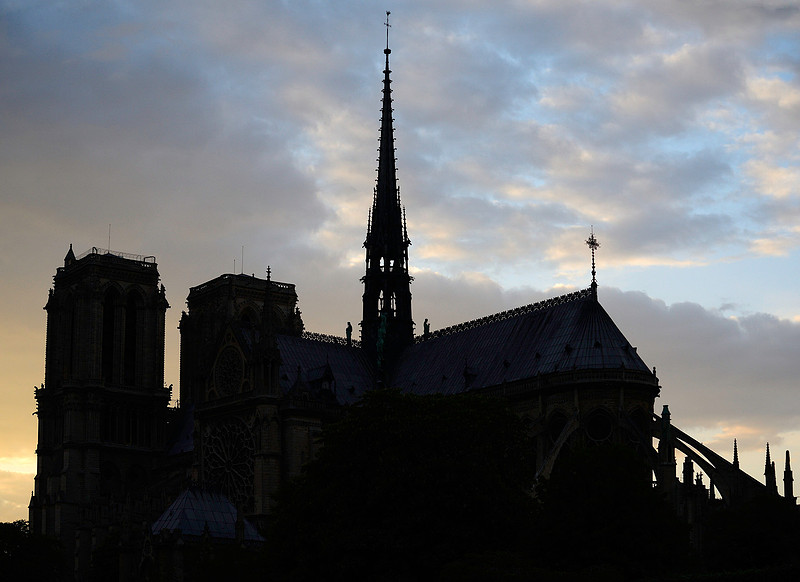
I have always admired the daring of the French in taking aesthetic risks with urban planning and redevelopment. This is not just a matter of recent history, exampled by the Pyramide du Louvre, or the Centre Beaubourg. This “contre jour” image of Notre Dame de Paris emphasises the vision of the Commission des Monuments Historiques and the magisterial daring of the architect Viollet-le-Duc, who “restored” Notre Dame between 1845 and 1864.
Restoring Or Remaking?
When I first saw it as a child and for many subsequent visits, I did not know that the breathtakingly delicate and uplifting silhouette of this spiritual and mythical building (thank-you Victor Hugo!) is almost entirely due to a 19th century remake, using a romanticized vision of gothic architecture. The official website of Notre Dame quotes Viollet Le Duc thus: “To restore an edifice is not to maintain it, repair it or remake it, it is to re-establish it in a complete state that may never have existed at a given moment”. See http://www.notredamedeparis.fr/spip.php?article406
That said, I am so used to today’s profile, that I was astonished to see how squat and square was the original edifice, when I researched the original architecture of the building. In fact, the central roof on which the current spire was constructed was bare, since the original 13th century bell tower had been demolished during the French Revolution.
Viollet le Duc’s approach was the antithesis of modern curatorship, which preaches restoration of art to its original form and using materials that can be subsequently removed or replaced, without harming the art. He applied his own aesthetic flair to the building, inside and out, adding flourishes and symbolism everywhere, rivaling the gothic exuberance of the original stonework with wood and metal additions that line the roof in the central section of the image. What genius to take the risk of “jazzing it up”!
100 Years Ago Today…
On this centenary day of the start of World War I, I am also struck by the survival of this extraordinary work of art. It is miraculous that none of the Franco Prussian War of 1870, World War I, or World War II led to massive destruction of Paris’ architectural gems, notwithstanding the potential from heavy artillery and lethal aviation present during the encirclement, or actual occupation by the Communards, the German forces, or the Allies.
The large-scale destruction or vandalism which did take place in Paris has been at the hands of Parisian revolutionaries and the Parisian city authorities. Although the latter’s work is often inspired, such as during the era of Baron Haussmann, there have been periods of real vandalisation, such as during the French Revolution, the Commune and, more recently, the mandate of President Pompidou. He has our grateful thanks for approving the Tour Montparnasse, for example.
Taking An Imperfect Photograph
As so often, the captured image was a hurried response to a fleeting moment. I took it near sunset, when the lighting conditions offered a perfect “contre jour”/ “against the light” profile of the features I enthuse about above. I was not out on a planned architectural photography project, therefore I was not equipped with a Perspective Control lens, a wide-angle lens, or a tripod. I had to do the best I could with a 60mm, prime lens and a monopod. Luckily for my desire to capture architectural detail, this lens does have excellent sharpness.
Another major downside was framing the photograph in such a way as to minimize perspective distortion, known as the “keystone” or tombstone” effect. I could not keep the whole building in view and in proper perspective by distancing myself further from the building and shooting with the lens at a right angle to the ground, since this option would have involved me falling into the river Seine, so I had to take the risk of angling the lens upwards on the monopod standing on a nearby bridge.
I ensured that the main perpendicular that would be correct at capture was the spire in image centre, but I knew that the outlying edges of the building would still be distorted into non-vertical lines.
Making An Imperfect Correction
The image above has had some perspective correction, using my standard Nikon image processing software. It may be that using the keystone correction tools in Photoshop would resolve the issue better, but that is for another day. I find that the peripheral distortion in the image I present distracts little from the impact of the central roof detail that is my focus.
Technical
As always, the combination of ISO, aperture and speed was a trade-off between image quality (ISO 640), adequate depth of field (very marginal aperture choice of f5) and the resultant speed (1/640th second, moderately adequate to avoid the effect of camera shake). Higher quality choices of better ISO, smaller aperture and faster speed were denied by the falling light conditions.
Camera: Nikon D800 Lens: 60mm prime f2,8 Focus Mode: AF-C single Aperture: f/5 Shutter Speed: 1/640s Auto Focus -Area Mode: Single Exposure Mode: Aperture Priority Exposure Compensation : 0EV Metering: Spot ISO Sensitivity: 640 Mounted on a Monopod
I love this building. It has touched my spirit on different levels. I hope it does something of the same for you.
Copyright Paul Grayson 2014
Keywords:
60mm Prime,
Dame,
Fine Art,
Nikon Capture NX2,
Nikon D800,
Notre,
Paris,
Paris",
Paul Grayson,
Photeinos,
de,
φωτεινος

Comments
No comments posted.
Loading...
|